


I came across this article today: Things I Don’t Like in Configuration Languages. It mentions an overwhelming number of configuration languages. XML, JSON and YAML are well known, but there are many others, some of which I have heard about and even used (for example, I have used TOML, JSON5 and JSONC); others were entirely new to me (there are more JSON variants than I realized). The article didn’t even mention KYAML.
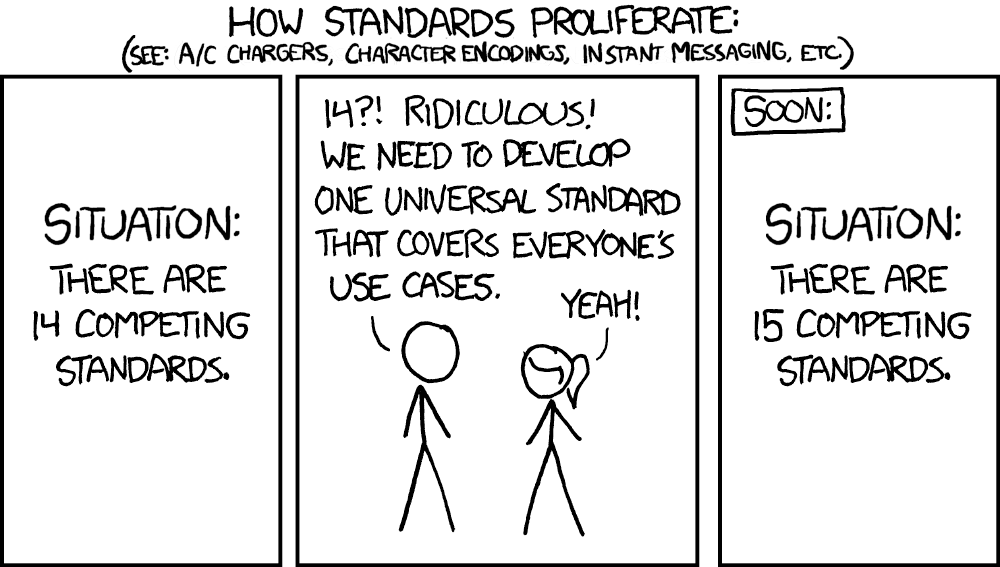
What’s the solution for this mess? More configuration languages!
MAML
Quote
Minimal. Human-readable. Machine-parsable.
Rationale
JSON is the most popular data-interchange format. But it isn’t a very good configuration language.
MAML keeps JSON’s simplicity and adds only the needed bits for a good configuration language:
- Comments
- Multiline raw strings
- Optional commas
- Optional key quotes
- Ordered key-value objects
MAML is human-readable and easy to parse.
Not to be confused with Microsoft Assistance Markup Language.
MAML aims to build on JSON’s strengths and overcome its shortcomings.
TOON
Quote
Token-Oriented Object Notation (TOON) Token-Oriented Object Notation is a compact, human-readable encoding of the JSON data model for LLM prompts. It provides a lossless serialization of the same objects, arrays, and primitives as JSON, but in a syntax that minimizes tokens and makes structure easy for models to follow.
TOON combines YAML’s indentation-based structure for nested objects with a CSV-style tabular layout for uniform arrays. TOON’s sweet spot is uniform arrays of objects (multiple fields per row, same structure across items), achieving CSV-like compactness while adding explicit structure that helps LLMs parse and validate data reliably. For deeply nested or non-uniform data, JSON may be more efficient.
The similarity to CSV is intentional: CSV is simple and ubiquitous, and TOON aims to keep that familiarity while remaining a lossless, drop-in representation of JSON for Large Language Models.
Think of it as a translation layer: use JSON programmatically, and encode it as TOON for LLM input.
TOON aims to be a token-efficient JSON alternative for LLM prompts. It takes inspiration from YAML and CSV.
My Opinion
Unlike KYAML, which I tried out almost as soon as I found out about it, I don’t think I will be an early adopter of either MAML or TOON. I still don’t quite understand MAML’s rationale, but will be reading more about it. As for TOON, beyond the initial hype, it’s still not clear how good it actually is. Let’s see if either of these gains any traction.
Featured image by Ferenc Almasi on Unsplash.