
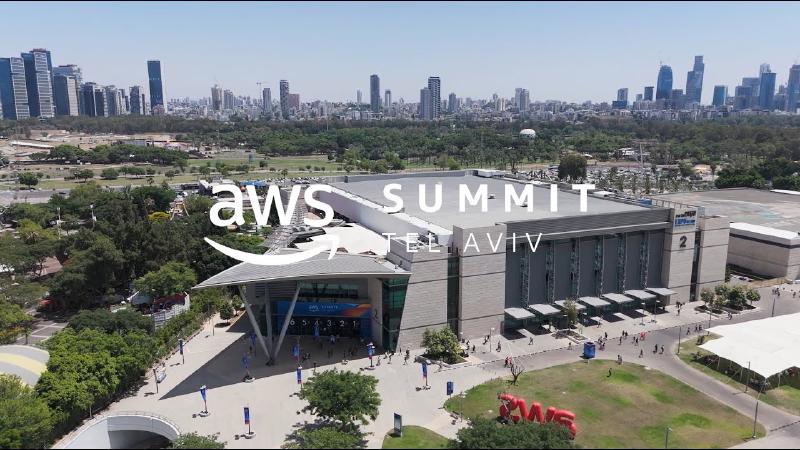
A common saying within the Israeli tech industry is that it’s a small industry where everyone knows each other and connections are extremely important. The cloud computing and DevOps industry is an even smaller niche within the greater tech industry. At AWS Summit, held at Expo Tel Aviv each year, it feels like I meet half of my industry. Over ten thousand people attend this event every time it’s held.
Third Year, Familiar Ground
This was my third year at AWS Summit Tel Aviv. It still feels exciting, but it is also more familiar now. The once-intimidating large Expo halls feel more familiar; I knew where to go to find the sessions that I planned on attending, the delicious complimentary food and everything in between. I also knew the best places to find those elusive power outlets, to be able to charge my devices. Most importantly, I knew it’s better to focus on attending a few sessions that genuinely interest me, rather than trying to go to everything. With 90 sessions available this year, attending everything simply isn’t possible.
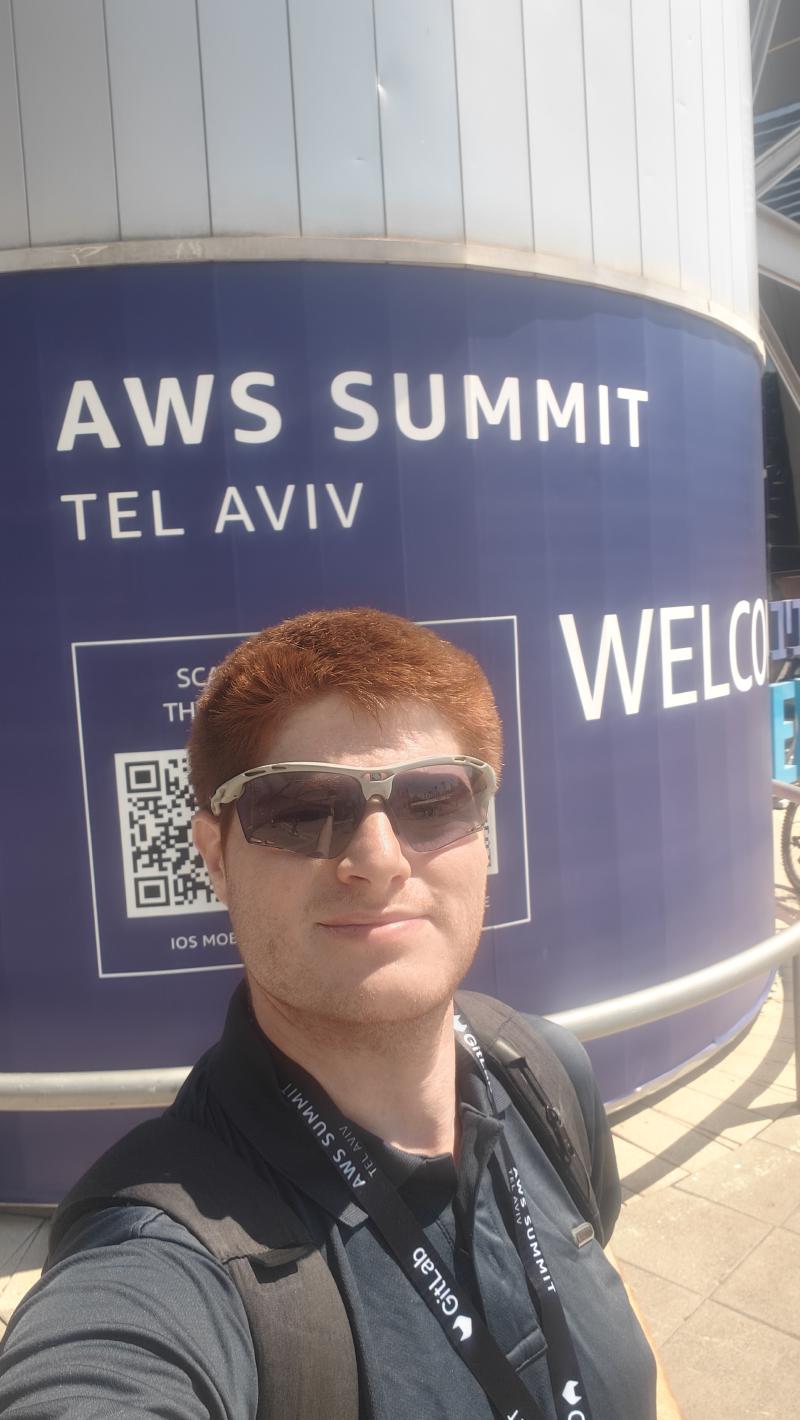
The two sessions I chose were worth the time.
EKS keeps absorbing the operational work
The first session I attended was “Simplify your Kubernetes journey with Amazon EKS Capabilities”.
The useful part was seeing where AWS is drawing the boundary around managed Kubernetes. A lot of the components teams currently install and operate themselves sit around workload orchestration and resource management. The new EKS capabilities move more of that work under AWS management.
That tradeoff is familiar. Running an open source component yourself gives you control, but it also gives you another upgrade path, another failure mode, and another set of defaults to understand. A managed capability removes some of that work, but only if its limits match what your workloads need. I want to spend more time with the actual implementation before deciding where that tradeoff makes sense.
To further demonstrate the utility, Daniel Rubin, Staff DevOps Engineer at Gong, spoke about how they used Amazon EKS and Argo CD on a global scale. That’s often my favorite part of cloud conferences: hearing about how teams manage infrastructure at massive scale.
Argo for agent pipelines
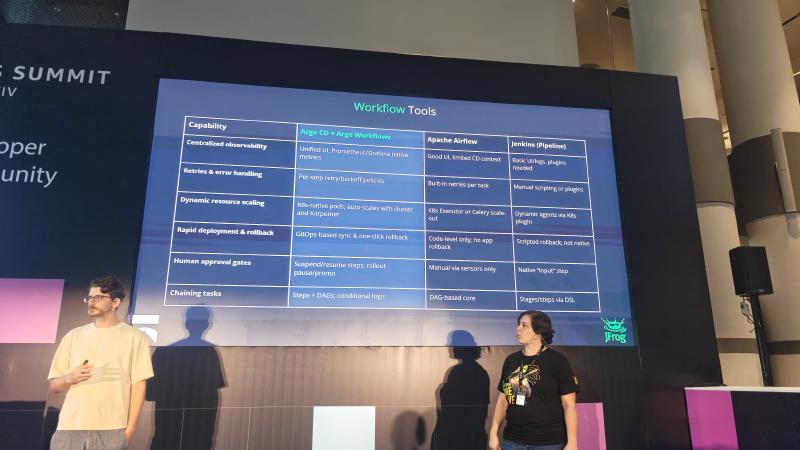
The other session was “GitOps for AI Agents: Building Reliable AI Pipelines with EKS and Argo”, presented by Shiran Melamed and Benji Kalman from JFrog and Root respectively (the latter company, Root, was recently acquired by Aikido).
The architecture was close to systems I already know: Argo Workflows ran the agent pipelines, Karpenter handled node provisioning, and Argo CD kept the Kubernetes environment in sync through GitOps.
I am skeptical of the amount of AI branding being attached to ordinary engineering problems right now. Still, agents create real orchestration problems. Their work needs scheduling, retries, isolation, resource allocation, and a deployment process that can be reviewed. Argo and Kubernetes already have useful answers for those problems. The session was interesting because it focused on those mechanics instead of treating “agentic” as an architecture by itself.
Networking at the Expo Hall
This year I wanted to focus on networking and making new connections, as well as reconnecting with acquaintances. At the AWS Expo Hall, I talked with several companies to hear who’s recruiting. Companies are actively looking for people who are experienced in cloud computing, DevOps methodologies and Kubernetes, as well as in CI/CD, GitOps and Infrastructure as Code, the exact technologies and skills I’ve been focusing on in my career.
At the same time, the most interesting connections have been the ones that are not about jobs at all, but more personal connections about shared passions. At the Pulumi and Robusta booths, I was able to talk to employees who maintain the open source projects of each respective company. They each seemed genuinely passionate about their work, and I was able to have insightful conversations with them.
At the Pulumi booth, I mentioned that the Pulumi project has been offering a viable alternative to CDKTF, since HashiCorp archived the terraform-cdk repository in December 2025. The Pulumi employees told me about CDK Terrain, a community fork of CDKTF. Then at the Robusta booth, I mentioned I have recently been trying Robusta KRR (Kubernetes Resource Recommender) and added it to my homelab cluster earlier this week. The Robusta employees mentioned donating HolmesGPT to the Cloud Native Computing Foundation and encouraged me to contribute to their open source projects.
Wrapping Up
The day ended with a live music show, starring Tuna. As I got home, I reflected on an eventful day. That day I walked 17,000 steps, made new connections, learned new things, and solidified my understanding of the cloud native world and where it’s heading.